Showing posts with label Church. Show all posts

Friday, April 2, 2010

I am preaching tonight. I just printed off the hard copy of my sermon, which is always a relief!

This is the first sermon I've preached in church that is completely new material -- the only other sermon I've given so far (last Thanksgiving) drew heavily from a sermon I wrote for a seminary class. So I'm excited -- but also nervous.

You see, this sermon will not be a "textbook" sermon. I was trained in an (über-) evangelical seminary that has VERY strong opinions/beliefs about what makes a good sermon -- or even what makes a "real" sermon. In two words: consecutive exposition. Line-by-line exegesis of the biblical text. A clear outline, with a clear "proposition" offered, preferably at the beginning of the sermon. Each main point anchored in the text, backed up with illustrations and explanation. Highly linear.

Well, I just couldn't force my sermon into that kind of rhetorical corset this time around. Part of me wanted to -- the part that says, "People will judge you if you don't give a technically excellent sermon -- especially since you're a girl." I'm still a bit scared that I will be dismissed tonight because my sermon is more fluid than linear.

But I just couldn't do it. My sense is that what God wants to do tonight, through the texts, music, liturgy, and sermon, is to move the congregation -- for the significance of good Friday to sink into hearts, not just enter into minds. You see, sometimes exegesis keeps us at a distance, comfortably removed from the text, under the illusion that we can approach God objectively and cognitively. But God wants more than (though not less than) our minds.

My congregation is well educated and well churched. And that's good! But it can also numb us to the impact events like Good Friday ought to have on our hearts. So tonight, I'm taking a risk -- and I pray that God will use it.

Thursday, December 24, 2009

Great, great article by Mark Galli at Christianity Today:

How to Have a Merry Christmas: And It Doesn't Require You Doing Another Blessed Thing

Galli points out how religion becomes oppressive when it is about "doing, doing, doing" (more manageable) rather than about love for God (more mysterious). Enjoy!

Saturday, August 22, 2009

As much as I disagree with him on certain points, I try to respect John Piper as a faithful servant of God -- really I do. But things like this make me very nervous and a more than slightly sad. I've been thinking a lot about how difficult it is to challenge things in our culture that we think are wrong without completely turning people off to the church and Christianity, and even to the core message of the gospel. I don't have a lot of answers at this point -- just questions, theories, and an underlying sadness.

At times like this, all I can think to do is to pray, "Your kingdom come, Your will be done on earth as it is in heaven." But Lord... let me see it here on earth too.

Check out Scot McKnight's post and discussion on Piper's comments: "The Minneapolis Tornado and John Piper".

Saturday, July 11, 2009

Bearing Witness to the Good Shepherd

God is good. He is the Shepherd, the one who provides good things for His sheep over and above what they even imagine. Yes, we know this is true. But like any deep truth, it's easy to doubt God's goodness and care when He "feels" far away, or when our circumstances leave us desperate and needy and it seems like no one can help us. So often in this past year when I've been in that place of desperate need, I've known that God IS able to help, rescue, and provide, but it has seemed like He just... doesn't. Like He was just watching me thrash but not intervening.

In those moments, sometimes I would get angry at Him. "Why aren't you helping me?! I know I'm not able to help myself, but it feels like I have to just keep trying to pull myself up out of this pit, because You obviously are just going to keep watching me, motionless, and I can't just lay here waiting for You to act." In those moments, the tension between what I knew in my head about God (His goodness, His power, His provision) seemed to directly conflict with my experience of helplessness, of powerlessness, of desperation, of unmet need.

But my frustration and doubt dissolved into wonder and gratitude when God answered my deepest prayers more abundantly than I even dared to believe was possible. Specifically, I had been praying to be able to stay in ministry at my church. Now that I've graduated from seminary, student loan payments loom in the near future, and a part-time music minister can't quite survive on the North Shore without finding another job. I longed to be full-time at my church, but it seemed impossible - these are difficult times for everyone, and we are a small congregation.

But God was working behind the scenes, even when it seemed like He was motionless. A couple good friends stepped in to be advocates for me in a time when I could not be an advocate for myself. Thanks to them, the leaders of my church found the money and the need for a new position, a position basically tailor-made for me. A full-time position that allows me to stay where I feel called and actually DO what I long to do and what I've been preparing for in seminary for four years. I never thought it possible, but I am now the Pastor for Worship and Congregational Care at my church. It still feels like a miracle!

I am so, so, grateful - for the friends that stood up for me, for the church that has affirmed me, but most of all for God's lavish provision for me. When I first found out about my new position, I had this incredible sense of how ungrateful I have been in these last few months, of the extent of my lack of faith. I felt like God was probably sitting in heaven, shaking his head in gentle amusement and saying, "See? What were you so worried about? Didn't you know I'd take care of You?"

I wish I could say that receiving this provision has finally cured my lack of faith, but it hasn't. I still get frustrated with God, but now I get frustrated with Him over some of my own friends who are still in the "desert." I long to see them restored, and I don't understand why God seems to work so slowly.

But He does work. He works in His own time, but He works powerfully and lavishly. He IS the God who restores, and for His children the experience of the wilderness is never wasted. I don't always understand His timing, but I am slowly learning to trust that He knows what is best. And He is always good.

I don't deserve the richness of this new blessing - and perhaps that's why receiving this grace makes me so, so grateful.

Wednesday, July 1, 2009

Everything You [n]Ever Wanted to Know About the Anglican Provincial Assembly

Well, I promised I would post my reflections on the Anglican Provincial Assembly, so here goes nothing. Some of you might find this incredibly boring... but I'll try to make it informative AND at least slightly opinionated in order to keep it interesting.

First, a couple basic facts about the Assembly:
  • Over 800 attendees from all over North America, as well as some representatives from the global Anglican Communion. 234 of these attendees (including me!) were voting delegates, representing 28 dioceses or dioceses-in-formation.
  • Purpose of the Assembly: formally launch the Anglican Church of North America (ACNA), by ratifying the Constitution and Canons and installing Bishop Bob Duncan as Archbishop and Primate of the ACNA.
  • Leaders of the various Anglican groups represented at the Assembly had worked on the proposed documents for many months, following up from last summer's GAFCON conference, and with the blessing of the GAFCON Primates. In other words, this was not an Assembly that just popped up out of nowhere - it's been a long time coming.
  • Outcome of the Assembly: Constitution and Canons passed without a hitch. Archbishop installed in a beautiful service. Many attendees ecstatic that they finally have a new Province, a church of their own for orthodox Anglicans in North America.
I'm actually in this picture if you look reaaaaal closely...


Ok, enough with being "objective." If you want to read a more complete "objective" synopsis of the Assembly, check out this week's e-update from Church of the Redeemer [link to be posted soon].

I went to the Assembly with a lot of questions about the ACNA, the primary question being, "Is this movement something GOD is doing or something HUMANS are doing?" Granted, on this earth it's never completely one or the other, but I think the balance usually falls to one side more than the other. For example, when I attend AMiA Winter Conferences, I come home absolutely convinced that God is working through AMiA. I hoped that in attending the Provincial Assembly, I would get a better sense of how to evaluate the ACNA.

However, I left asking that same question - which surprised me a bit, considering the fact that during most of my time in Texas I was surrounded by people who are completely sold on the idea of the ACNA, who really believe that this Assembly marked a turning point for Anglicanism in the West, and who believe that God is bringing about a great reformation of the Western church in part through the efforts of North American Anglicans to stand for orthdoxy.

Maybe.

May it be.

But I have some concerns, which make me thankful that AMiA is staying AMiA, even as we are part of the ACNA (yeah, it's complicated... check out Bishop Murphy's statement).
  • One of my biggest concerns is that the ACNA is emphasizing unity so strongly that honest discussion about differences is not occurring at this point... and that frightens me. There is a lot of history among the people ACNA is bringing together, and not all of it is Christ-like. In particular, some of the people who are now part of ACNA were highly critical toward AMiA when our leaders first turned to the global primates for "refuge" almost ten years ago. From what I gather, some of these old hurts have not been fully addressed; in fact, while I was at the assembly I sensed some general negativity toward AMiA from the other delegates. And we're not talking about it... That can be dangerous. Without some honest dialogue, confession, and forgiveness, there will be no true unity. Will ACNA foster dialogue or just say "forgive and forget" without doing the hard work the has to precede forgiveness? In my book, the jury is still out...
  • Related to that, ACNA encompasses a variety of opinions about some hot-button issues, of which the most volatile is undoubtably women's ordination. Duncan's approach (written into the ACNA Constitution itself) is to say that as of right now this new Province will pass no law altering what individual groups and dioceses already allow concerning the ordination of women (particularly to the priesthood). To paraphrase ++Duncan, "we'll let God sort that issue out in His own time." I like this approach, but I can already tell that it bothers some people, particularly those who are most against women's ordination. My fear is that our enemy will get hold of these differences and tear the ACNA apart before it even gets off the ground... I fear that without much prayer, ACNA could become just another Christian group torn apart by anger, malice, and every other sin that threatens true unity. Pray, pray, pray...
  • Finally, I have a sense that some, and perhaps even many, of those joining the ACNA are what I sometimes call "hard-core" Anglicans. To me, hard-core Anglicans are people who place high value on the nitty-gritty details of the Anglican tradition -- they can be snobby about things like which prayer book a group uses and whether the service music was dignified enough. Now, I'm all for the importance of tradition, BUT at the same time, I think there's an approach to liturgy and tradition that crystallizes it as "THE way" and actually deadens it, rather than letting it live and breathe and flex a bit. Anyway, all that to say that I fear the ACNA will be more focused on building church structure and continuing "right" tradition (in reaction against the Episcopal Church) that it neglects mission. In the words of an excellent article I read on this subject, I am worried that in ACNA, like in TEC, "causes replace gospel and self-authentication replaces mission."
It doesn't have to be this way. It could be that ACNA will prove to be more than a reactionary movement, more than just one more Christian splinter group that breaks away and then just keeps on splintering. But I am concerned, and concerned enough that I am thankful that AMiA is staying AMiA and continuing its attempts to be faithful to the calling we have received in North America and in partnership with Rwanda.

Forming a new Province is not as simple as ratifying a couple of documents. Forming a new Province, a new body of united Anglicans in North America, is a long process that requires a great deal of prayer and honest dialogue about past hurts and current differences. Unity cannot emerge simple by saying “we are united.” The hardest work of the ACNA might just be yet to come…

And in the meantime, let us pray.

Newly installed ACNA Archbishop Robert Duncan, a.k.a. "Crazy Eyebrows"

Wednesday, May 6, 2009

Gifts vs. Roles

Check out this great article on the False Distinction Between Gifts and Roles that many people in the church buy into.* The article is from a blog sponsored by Christianity Today called "Gifted for Leadership," and this particular article is written by a graduate of TEDS, Sarah Flashing. She challenges the church, and particularly women, to think more deeply about what it means to honor God with the spiritual gifts he has placed in us. She also has a great discussion of what submission ought to look like in the church, emphasizing that submission is NOT a "giving up" (negative, shutting down one's gifts) but rather a "giving to" another person (a positive act of love, not a denial of pleasures).

Check it out!


*Forgive the preposition at the end of this sentence, but it sounded way too awkward to write "into which many people in the church buy." As far as I'm concerned, I chose the lesser of the evils!

Friday, December 12, 2008

Whoa there...

Ok, so this morning I'm reading along, trying to finish up a textbook for American Church History, and then BAM! I run into this paragraph:
"Some denominations, rather than taking steps in the direction of female ordination and greater leadership opportunities for women, have taken steps in the opposite direction. The Southern Baptist Convention had ordained women as early as 1964 and by the mid-1980s had ordained over 400 women. By that time, however, ordaining women to the ministry had become highly controversial, with an increasingly conservative leadership becoming ever more outspoken in opposition to such action. At its 1984 annual meeting, in a crucial fundamentalist move, the Southern Baptist Convention declared that women should not assume a role of authority over men. Women were to be excluded from the pastoral ministry to 'preserve a submission God requires because the man was first in creation and the woman was first in the Edenic fall.' In 1986 the convention's Home Mission Board voted not to grant funds to any church that employed a woman pastor, and then in 1998 the convention capped its reactionary turn by declaring the women were to practice 'gracious' submission to their husband's leadership."
~Edwin Gaustad & Leigh Schmidt, The Religious History of America, 389 (emphasis mine).~

Whoa there! I had no idea that the SBC had ordained women at one time! Can you imagine being one of those women who had been ordained, then told that their callings were invalid so they couldn't be pastors anymore? And it's prrrrretty interesting that their conservative position on women's submission did not formally crystallize until the 1980s. Granted, you can't make an argument for women's ordination (or for egalitarianism) based on this fact, but I'm just saying...

Perhaps we should all recognize that the way these debates unfold in the U.S. are as much cultural as theological.

Wednesday, October 1, 2008

Collect

One of the best things about planning music for church is that I get a sneak preview of where the Lectionary will lead us each week. I find this week's Collect particularly powerful (from the BCP).

Almighty and everlasting God, you are always more ready to hear than we to pray, and to give more than we either desire or deserve: Pour upon us the abundance of your mercy, forgiving us those things of which our conscience is afraid, and giving us those good things for which we are not worthy to ask, except through the merits and mediation of Jesus Christ our Savior; who lives and reigns with you and the Holy Spirit, one God, for ever and ever. Amen.
The Lectionary Page

Wednesday, September 10, 2008

Christian Dating Link

Oh, MY gosh. I can't believe this link is real. Ok, actually I can, but it still makes me feel like I either am going to be sick or laugh for days.

"Christians Learn the Art of Dating"

Apparently Christians increasingly are going to dating workshops these days to "improve their technique" by learning body language and Christian pick up lines. Ok, fine, some of these lines are funny (my favorite is "The name is Will. God's Will"). But seriously... am I really naïve, or is this just plain silly?!!

Sunday, August 24, 2008

Tasting Grace


I love attending a liturgical church. And I love receiving the Lord's Supper every week. That meaning of that ritual sinks deeper and deeper into my soul each time I come to the table, although I still feel that I understand what exactly happens in the Eucharist so little!

Today was one of those days that I felt like I really "got it" -- that just for a brief second, I understood the power of receiving the consecrated elements. It had been one of those Sunday mornings where the cares of the world just refused to stop following me around the sanctuary, bouncing on my shoulders and poking me in the mind so that it was hard for me to enter into worship, even while leading the music. But when it came time for me to receive the bread and wine up in front with the other musicians, something quietly extraordinary happened.

It was as if during the whole service up to that point, I had been seeing and moving through a viscous liquid that held me back, but when the bread was offered to me with the words "This is the body of Christ, the bread of heaven" and the priest's eyes looking directly into mine, suddenly the air around me was pure again. "Lord, I receive you -- all that you desire to give to me, all that is mine already in Christ -- Lord, heal me, strengthen my faith, fill me, thank you." The communion bread was sweet, soft, a slightly larger morsel than usual -- today, I could literally taste the Spirit speaking, "See? I do not skimp on the gifts I give to you. Taste my grace. You do not need to plead with me for crumbs. Receive my healing." And the communion wine, offered to me by the catechist, had never tasted so wonderful to me as it did today.

Truly, truly we sang, "Taste and see, taste and see the goodness of the Lord."

Tuesday, June 24, 2008

GAFCON

Anglicanism has been all over the news this week due to the meetings occurring in Jerusalem known as GAFCON (Global Anglican Future Conference). Many see GAFCON as the conservative "alternate" to the Lambeth conference, the gathering of Anglican bishops from all over the world that occurs only every 10 years and will convene again this coming July.

A lot of controversy surrounds both conferences. The rumors swirl especially vigorously around GAFCON, for many suspect that the more conservative church leaders meeting in Jerusalem are determined to form another Anglican communion in protest against what conservatives see as the "wayward" beliefs and practices of large sections of the Western Anglican church (such as the Episcopal Church in the States).

Though the conflict over ordination of homosexual bishops in the Anglican church gets top billing in the news, the dividing issues in global Anglicanism are far deeper and more expansive than this one issue. Here's one helpful link that compares conservative and liberal views on a number of points: "Anglican Rift: Conservative v. Liberal."

NOTE: This link is from BBC News. It doesn't quite get at another, perhaps THE, core issue between liberals and conservatives in the Anglican church: the doctrine of Scripture, as well as the related issue of authority in the church. The two "sides" seem to take fundamentally different approaches to these central questions, which is more concerning to me than debates (though legitimate) over morality and who-should-be-ordained.

Another link: GAFCON photoblog (found it on TitusOneNine)

[Cartoon from http://www.standfirminfaith.com/index.php/site/article/9509/.]

Friday, March 7, 2008

Brief Thought for the Day

"The distance [from our own cultures] forged by the Spirit of new creation . . . entails a judgment against evil in every culture. . . . The judgment must begin, however, 'with the household of God' (1 Peter 4:17)--with the self and its own culture. . . . Similarly, those who seek to overcome evil must fight it first of all in their own selves."

~Miroslav Volf, Exclusion and Embrace (52)
As I was reading today, this quote particularly captured my attention. First, I appreciated that Volf was able to affirm that Christians are called to be BOTH drastically accepting of others (the Holy Spirit "creates space in us to receive the other" - 51) AND holding onto moral judgments of right and wrong. Most of us seem to deemphasize one or the other, but both together are Christian.

Second, the biblical statement, "judgment begins with the household of God" hit me powerfully. Do we take this seriously? Yes, we preach piety and moral values, but do we really engage in the hard work it takes to root out deep seated evils from ourselves and our communities? Do we preach at those who lack the Spirit, condemning them for their "evil ways," while we who have surrendered to the Spirit's claims walk blindly in the darkness? I fear that too many in American churches have a "form of godliness" while denying its power. . .

What do you think?

Sunday, March 2, 2008

Mingled Waters

"Blessed are the poor in spirit, for they shall see God."

There is a deep brokenness to life. Some days I know it more than others. Some days I feel the Fall like a dull ache, a heaviness upon my chest. Some days, I find it easy to mourn with those who mourn and weep with those who weep, because my whole being is tuned to that inexpressible groaning of creation and our common longing to be whole again.

Today was one of those days. Heavy thoughts and conversations from the past few days sunk into my body overnight, and I woke with grief. With awareness of my own sins and failures as well as awareness of the tragic gaps between us and others, some of our own making, some that just . . . appear. I came to church dwelling very much in Lent.

At church, music rehearsal was dominated by the absence of our sound technician and corresponding problems, particularly since we use an electric keyboard rather than an actual piano. No sound = no keyboard. I was actually expecting a few snafoos during the morning, since our pastor was out of town, so I wasn't surprised. We never actually accomplished a full sound check, so when the service began, it was difficult for us musicians to hear one another -- Muffled notes in the sanctuary, my own voice and the rhythms of guitar close by.

The confirmation class that met before the service lasted until about 3 minutes before the service begins, making me antsy about getting upstairs and preparing to begin.

With a visiting preacher often comes a few other bumps in the liturgical road. Today, the pastor accidentally prepared a sermon from 2 Samuel 16 rather than 1 Samuel 16, so that the Old Testament reading that appeared in the bulletin did not match the sermon.

Somehow the third verse of the closing song did not get printed in the bulletin, so Elisa and I sang an inadvertent duet.

Why this litany of "failures" during corporate worship? Because despite these glitches, God made His presence known. Despite the poor monitor levels, the congregation was engaged in singing. Despite the Samuel mix-up, God's word was preached in power. Just as God worked in the service in spite of our human errors, so God works in us in the midst of our brokenness.

There is always a brokenness inherent in anything we do in this life, whether we are aware of it or not. In times when things run smoothly, it is easy for pride to take us captive so that we congratulate ourselves on our own competence, whether in our "excellent worship," or the "practical wisdom" we graciously extend to our friends, or our superior business sense, or our self-awareness ("why can't others simply be considerate like me?").

Pride does not lean on God's grace. For this is what makes me thankful for the days in which I dwell in brokenness: the deeper my sense of the brokenness, the greater my sense of God's grace. God has not abandoned us to brokenness. God does not disregard our pain, our failed relationships, our damaged emotions, our deluded thoughts. There is healing, joy that we only experience to the extent to which we have known the pain. Without brokenness, we would not see the radiance of redemption.

There is an undercurrent of deep sadness in life, but that mournful stream empties out into the vast, broad, deep, wide River of Life. Right now, the two streams are mingled, and as I drink from the river, I must taste both bitter and sweet.
But someday, ahh! someday . . .

"For I consider that the sufferings of this present time are not worth comparing with the glory that is to be revealed to us."

Tuesday, February 26, 2008

Bandwagoning


I have recently begun to follow a couple of blogs/news sites giving updates on global Anglicanism. My favorite site posted some great quotes yesterday, which I thought I would pass along here.

First, a couple of quotes from leaders in the Episcopal church who are trying desperately to keep conservatives from leaving the mainline fold:

"I am very struck by our failure to communicate."
--Presiding Bishop Katharine Jefferts Schori to clergy of the diocese of South Carolina

This cracks me up! Understatement of the year award slash missing the point entirely!

Meanwhile, in Kentucky...

" 'We're having a family argument,' said [Rev. Katherine] Grieb, a Virginia Theological Seminary biblical scholar and a member of a team drafting a 'covenant' to hold together the Anglican Communion, which consists of the Episcopal Church and other national churches descended from the Church of England.

'There never was a golden age when everybody in the church agreed about everything,' she said at the gathering at St. Peter's Episcopal Church in southwestern Jefferson County."

Ok, true, but as Rev. Canon Dr. Kendall Harmon (the man behind my favorite Anglican site) responds:

"It is so very sad to see a ...[Church leader] once again parlaying the ECUSA hierarchy’s offical party line which is: to be Episcopal means to agree to disagree agreeably, we have been through struggles before, and this is yet another struggle through which the church will find her way.

The problem is the hidden theological assumption here that all theological differences are the same. They are NOT."

So true, so true. As Bishop Rogers emphasized at Winter Conference, unity comes through true doctrine, NOT through institutional bonds.

One more quote, this time from the BCP. Apparently yesterday was the Feast of St. Matthias, so although this is a day late, I thought it was worth sharing:

Almighty God, who in the place of Judas chose your faithful servant Matthias to be numbered among the Twelve: Grant that your Church, being delivered from false apostles, may always be guided and governed by faithful and true pastors; through Jesus Christ our Lord, who lives and reigns with you, in the unity of the Holy Spirit, one God, now and for ever. Amen.
Amen indeed.

Check it out: TitusOneNine

Thursday, February 14, 2008

Reluctant Emoter(s)

Rabbi Zusya, when he was an old man, said, "In the coming world, they will not ask me: 'Why were you not Moses?' They will ask me, 'Why were you not Zusya?'" The true vocation for every human being is, as Kierkegaard said, "the will to be oneself." ~Peter Scazzero, The Emotionally Healthy Church, p. 141.

As some of you may know, I describe myself as a "reluctant feeler." When I first took the Keirsey Temperament Sorter in seminary (yes, I am more-than-slightly obsessed with those four mystical letters, but that's another story), I was devastated when the test told me I am an "F," not a "T." In my mind, "F's" were weak, captive to each and every wave of emotion, certainly not qualified to study academic theology in the highest echelons of the British educational system. I wanted to be a "T," one of those dashing intellectuals, firing off spontaneous brilliances with perfect logic. I clung to the rationality and academic prowess I was proud to have built over the course of my up-teen years in school.

But God has shattered that false self-identity. By drawing me into an actual community, teaching me to pour into and draw deep from other people rather than hide beneath the brittle shell of books, studies, fear, shame, and deep loneliness, God has forced me to come to terms with my own inwardness. My fears of captivity to every emotional whim have not materialized, but I have begun to trust my emotions to tell me about reality--a different sort of reality than my intellectual synapses validate, perhaps, but reality nonetheless. Funny--my head knows that as whole people, permeated by Incarnation, our emotions are no less important than our cognition, but in practice I too often live entrapped in the Enlightenment, crowning rationality as the prince of all faculties.

Too often, I suspect, the church does the same. Too often, the church surrenders concern for engaging emotion to a few (charismatic?) denominations rather than seeking the healing, redeeming power of Christ for our emotions as part of our lives. For one of my classes, I am reading The Emotionally Healthy Church, by Peter Scazzero, and I can already tell that this book is going to affect me deeply. Scazzero argues that one of the primary reasons the church in the U.S. is in such dire straits is because we neglect to teach people how to mature emotionally as a necessary part of spiritual maturity. Right now, I can barely begin to process such an idea. But if my own experience is any indication--emotional and spiritual deepening blossoming as two roses on one prickly stem--beware, church! Emotions will out.

Interested in learning more about Peter Scazzero's ministery? Check out http://www.emotionallyhealthy.org/.

Sunday, January 27, 2008

Winds of the Ancient-Future

I just returned from a few unexpected days in Dallas for the Winter Conference of my denomination, the Anglican Mission in the Americas. While I had a wonderful time, I can tell it's going to take me awhile to fully digest the experience. So a few preliminary comments:


1) Ohhh, Dallas. Ohhh, Texas. Ohhh, memories of my days in the SBC... Enough said.


2) The unexpected:

(a) So much gray hair. Since the AMiA churches in which I have been involved have been largely powered by students coming out of more typical evangelical church backgrounds, I was taken aback by the number of older people involved in the convention, many of whom had been staunch members of the Episcopal church for years and years. These are the people who stood by their convictions and took action - it takes a lot of courage to leave family, friends, social ties, and beautiful buildings in search of orthodoxy.

(b) So many southern accents. Granted, you would think that the fact the conference was being held in Dallas would have tipped me off... but who knew that and Anglican denomination had so
many southern roots (apart from the Global South, that is)?

(c) Twinges of evangelical bland. Now, forgive me, but I am mightily prejudiced when it comes to worship styles - an unfortunate side-effect of co-leading worship at my own church and experiencing worship that reaches me as worship in "typical" evangelical churches rarely can. Since my own experience of worship in AMiA churches (here, I am thinking particularly, though not accurate theologically speaking, of music) has been extra-ordinary, I was not expecting the corporate worship at the conference to feel more "EFCA" than AMiA. Like I said, non-judging me is surprisingly opinionated when it comes to worship...

(d) Small fish, bigger pond. At the conference, I realized that I am not used to feeling overlooked as a Christian. In my own circles, right now I am a person that most everybody knows and respects; and it was a shock to go to conference and realize that most everybody there would probably look at me and see a young, short blond-ish girl, never expecting her to show signs of intellectual, spiritual, even emotional depth. It was good for me to swim in a bigger pond for awhile and to remember that God has given me a ministry that matters, and this is a wonderful thing!, but he has also called many, many people to bigger things than I can even imagine. Ah, that devious, creeping pride...
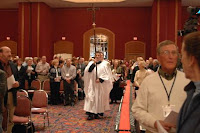
3) The narrow view:

(a) Good roommate times. One of my roommates was also at the conference, and we had an awesome time together of discussion, fun, and observation of awkwardness. It was one of those special times of getting to know a good friend even better and being privileged to see inner beauty and be affirmed in return. Plus, we got to, umm, imbibe (ah, the goodness of the Scotch!) with the rest of the staff at a "family establishment" called the Idle Rich. And, we got to see Juno after my bedtime.

(b) Personal clarity. In recent months, I have been wrestling with issues of calling and vocation. After being at conference, I am 99% sure that I am called to stay at Redeemer until "further notice." I long to dive into ministry, pour into people, learn to build a community; I see God working in my life and in my church, and I cannot walk away from that. PhD? Someday, perhaps, but in the meantime I believe I am ready (and called, and placed in my communities specifically) for action!

(c) Denominational clarity. I finally have a decent sense of what AMiA is, and what it means to be Anglican. If anyone is interested, I am more than happy to post Bishop John Roger's excellent synthesis of Anglicanism. After hearing him speak in a workshop, I realized that yes, I am Anglican! Good thing...

4) The far-beyond myself:
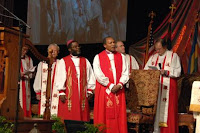
(a) Rwanda. I love, love, love the fact that we are under the authority of the bishops of Rwanda. I loved, loved, loved seeing and hearing from the bishops at the conference, especially in the final consecration ceremony when all the bishops were gathered on stage, lined up in a row as they laid hands on the new bishops, a brilliant wall of red in their vestments. I love the justice of Americans finally recognizing the value, indeed in many ways the greater spiritual maturity of Global Christianity.

(b)
God at work. After being at the conference, I am absolutely convinced that AMiA is God's project. I believe that we are in the middle of something big, something exciting, something utterly of the Spirit. Now, I tend to be cautious when I feel this way, since I never want to confuse my own intuition with recognition prompted by the Spirit, but at this point I can see the vision of AMiA, the commitment of the AMiA leaders, and the unique combination of factors that is fundamental to AMiA, and it leaves me breathless with gratitude that the Lord has allowed me to be a part of His work. I can't explain it fully -- I just watch, wait, respond, and pray.

Pray for AMiA. Pray for the church in America. Pray for revival from the Spirit. Pray for faithful leaders. Watch and pray, watch and pray.

BTW: the photos above are from an online article about the conference, by David W. Virtue. Check it out at http://www.virtueonline.org/portal/modules/news/article.php?storyid=7561