Showing posts with label AMiA. Show all posts

Thursday, May 19, 2011

Catching up (again...)

And once again, it's time to catch up.  This is why I will never be an excellent blogger. :)

1) I finished The Grapes of Wrath and really liked it, even though I didn't really enjoy reading it (does that make sense?  I think I just wasn't in the reading mood).  I can see why it's a classic, and I especially enjoyed the style in which Steinbeck wrote the book -- particularly the intermediary chapters that were more abstract and poetic than the actual storyline.  The book is sad, that's for sure.  I hate that the dog got killed.  And I hate the system Steinbeck describes, where the ginormous farms exploit the workers.  It made me understand the importance of unions, at least in a situation like that!  It also made me think about how far removed most Americans are from "the land" today, and how hard it is to make a living as a farmer -- and it seems to me that it just shouldn't be that way.  Should it?

On a lighter note, the name Rosasharn (the way the Joad family pronounces "Rose of Sharon") never fails to crack me up!  For all of you currently in the "family way," I recommend that you seriously consider naming your baby girl Rose of Sharon.  Come on, it's unique, right?

2) I am currently reading Crime and Punishment, and, much to my surprise, loving it!  I usually have a hard time connecting with Russian literature, but this time around I actually look forward to reading it.   I started out reading a hard copy of the book, but as an experiment I downloaded a free copy into the Kindle app on my iPhone, and now I'm reading the book on my iPhone exclusively.  This is my first foray into the world of e-reading.  So far, I'm enjoying it more than I thought I would.  Maybe it's due to the fact that with my iPhone I can read in bed while Erik is sleeping without using a flashlight...

3) On a non-literary note, a few weeks ago I was ordained as a deacon in the Anglican Mission!  Woohoo!  Here I am in my new duds with my bishop, my rector, a fellow deacon, and Erik:

Here I am with my parents, who came out from SoCal for the event:


And here is Melvin, my MIL's party flamingo, dressed up for the occasion:


And now, back to what I am actually supposed to be doing with my day...

Wednesday, July 1, 2009

Everything You [n]Ever Wanted to Know About the Anglican Provincial Assembly

Well, I promised I would post my reflections on the Anglican Provincial Assembly, so here goes nothing. Some of you might find this incredibly boring... but I'll try to make it informative AND at least slightly opinionated in order to keep it interesting.

First, a couple basic facts about the Assembly:
  • Over 800 attendees from all over North America, as well as some representatives from the global Anglican Communion. 234 of these attendees (including me!) were voting delegates, representing 28 dioceses or dioceses-in-formation.
  • Purpose of the Assembly: formally launch the Anglican Church of North America (ACNA), by ratifying the Constitution and Canons and installing Bishop Bob Duncan as Archbishop and Primate of the ACNA.
  • Leaders of the various Anglican groups represented at the Assembly had worked on the proposed documents for many months, following up from last summer's GAFCON conference, and with the blessing of the GAFCON Primates. In other words, this was not an Assembly that just popped up out of nowhere - it's been a long time coming.
  • Outcome of the Assembly: Constitution and Canons passed without a hitch. Archbishop installed in a beautiful service. Many attendees ecstatic that they finally have a new Province, a church of their own for orthodox Anglicans in North America.
I'm actually in this picture if you look reaaaaal closely...


Ok, enough with being "objective." If you want to read a more complete "objective" synopsis of the Assembly, check out this week's e-update from Church of the Redeemer [link to be posted soon].

I went to the Assembly with a lot of questions about the ACNA, the primary question being, "Is this movement something GOD is doing or something HUMANS are doing?" Granted, on this earth it's never completely one or the other, but I think the balance usually falls to one side more than the other. For example, when I attend AMiA Winter Conferences, I come home absolutely convinced that God is working through AMiA. I hoped that in attending the Provincial Assembly, I would get a better sense of how to evaluate the ACNA.

However, I left asking that same question - which surprised me a bit, considering the fact that during most of my time in Texas I was surrounded by people who are completely sold on the idea of the ACNA, who really believe that this Assembly marked a turning point for Anglicanism in the West, and who believe that God is bringing about a great reformation of the Western church in part through the efforts of North American Anglicans to stand for orthdoxy.

Maybe.

May it be.

But I have some concerns, which make me thankful that AMiA is staying AMiA, even as we are part of the ACNA (yeah, it's complicated... check out Bishop Murphy's statement).
  • One of my biggest concerns is that the ACNA is emphasizing unity so strongly that honest discussion about differences is not occurring at this point... and that frightens me. There is a lot of history among the people ACNA is bringing together, and not all of it is Christ-like. In particular, some of the people who are now part of ACNA were highly critical toward AMiA when our leaders first turned to the global primates for "refuge" almost ten years ago. From what I gather, some of these old hurts have not been fully addressed; in fact, while I was at the assembly I sensed some general negativity toward AMiA from the other delegates. And we're not talking about it... That can be dangerous. Without some honest dialogue, confession, and forgiveness, there will be no true unity. Will ACNA foster dialogue or just say "forgive and forget" without doing the hard work the has to precede forgiveness? In my book, the jury is still out...
  • Related to that, ACNA encompasses a variety of opinions about some hot-button issues, of which the most volatile is undoubtably women's ordination. Duncan's approach (written into the ACNA Constitution itself) is to say that as of right now this new Province will pass no law altering what individual groups and dioceses already allow concerning the ordination of women (particularly to the priesthood). To paraphrase ++Duncan, "we'll let God sort that issue out in His own time." I like this approach, but I can already tell that it bothers some people, particularly those who are most against women's ordination. My fear is that our enemy will get hold of these differences and tear the ACNA apart before it even gets off the ground... I fear that without much prayer, ACNA could become just another Christian group torn apart by anger, malice, and every other sin that threatens true unity. Pray, pray, pray...
  • Finally, I have a sense that some, and perhaps even many, of those joining the ACNA are what I sometimes call "hard-core" Anglicans. To me, hard-core Anglicans are people who place high value on the nitty-gritty details of the Anglican tradition -- they can be snobby about things like which prayer book a group uses and whether the service music was dignified enough. Now, I'm all for the importance of tradition, BUT at the same time, I think there's an approach to liturgy and tradition that crystallizes it as "THE way" and actually deadens it, rather than letting it live and breathe and flex a bit. Anyway, all that to say that I fear the ACNA will be more focused on building church structure and continuing "right" tradition (in reaction against the Episcopal Church) that it neglects mission. In the words of an excellent article I read on this subject, I am worried that in ACNA, like in TEC, "causes replace gospel and self-authentication replaces mission."
It doesn't have to be this way. It could be that ACNA will prove to be more than a reactionary movement, more than just one more Christian splinter group that breaks away and then just keeps on splintering. But I am concerned, and concerned enough that I am thankful that AMiA is staying AMiA and continuing its attempts to be faithful to the calling we have received in North America and in partnership with Rwanda.

Forming a new Province is not as simple as ratifying a couple of documents. Forming a new Province, a new body of united Anglicans in North America, is a long process that requires a great deal of prayer and honest dialogue about past hurts and current differences. Unity cannot emerge simple by saying “we are united.” The hardest work of the ACNA might just be yet to come…

And in the meantime, let us pray.

Newly installed ACNA Archbishop Robert Duncan, a.k.a. "Crazy Eyebrows"

Tuesday, June 24, 2008

GAFCON

Anglicanism has been all over the news this week due to the meetings occurring in Jerusalem known as GAFCON (Global Anglican Future Conference). Many see GAFCON as the conservative "alternate" to the Lambeth conference, the gathering of Anglican bishops from all over the world that occurs only every 10 years and will convene again this coming July.

A lot of controversy surrounds both conferences. The rumors swirl especially vigorously around GAFCON, for many suspect that the more conservative church leaders meeting in Jerusalem are determined to form another Anglican communion in protest against what conservatives see as the "wayward" beliefs and practices of large sections of the Western Anglican church (such as the Episcopal Church in the States).

Though the conflict over ordination of homosexual bishops in the Anglican church gets top billing in the news, the dividing issues in global Anglicanism are far deeper and more expansive than this one issue. Here's one helpful link that compares conservative and liberal views on a number of points: "Anglican Rift: Conservative v. Liberal."

NOTE: This link is from BBC News. It doesn't quite get at another, perhaps THE, core issue between liberals and conservatives in the Anglican church: the doctrine of Scripture, as well as the related issue of authority in the church. The two "sides" seem to take fundamentally different approaches to these central questions, which is more concerning to me than debates (though legitimate) over morality and who-should-be-ordained.

Another link: GAFCON photoblog (found it on TitusOneNine)

[Cartoon from http://www.standfirminfaith.com/index.php/site/article/9509/.]

Tuesday, February 26, 2008

Bandwagoning


I have recently begun to follow a couple of blogs/news sites giving updates on global Anglicanism. My favorite site posted some great quotes yesterday, which I thought I would pass along here.

First, a couple of quotes from leaders in the Episcopal church who are trying desperately to keep conservatives from leaving the mainline fold:

"I am very struck by our failure to communicate."
--Presiding Bishop Katharine Jefferts Schori to clergy of the diocese of South Carolina

This cracks me up! Understatement of the year award slash missing the point entirely!

Meanwhile, in Kentucky...

" 'We're having a family argument,' said [Rev. Katherine] Grieb, a Virginia Theological Seminary biblical scholar and a member of a team drafting a 'covenant' to hold together the Anglican Communion, which consists of the Episcopal Church and other national churches descended from the Church of England.

'There never was a golden age when everybody in the church agreed about everything,' she said at the gathering at St. Peter's Episcopal Church in southwestern Jefferson County."

Ok, true, but as Rev. Canon Dr. Kendall Harmon (the man behind my favorite Anglican site) responds:

"It is so very sad to see a ...[Church leader] once again parlaying the ECUSA hierarchy’s offical party line which is: to be Episcopal means to agree to disagree agreeably, we have been through struggles before, and this is yet another struggle through which the church will find her way.

The problem is the hidden theological assumption here that all theological differences are the same. They are NOT."

So true, so true. As Bishop Rogers emphasized at Winter Conference, unity comes through true doctrine, NOT through institutional bonds.

One more quote, this time from the BCP. Apparently yesterday was the Feast of St. Matthias, so although this is a day late, I thought it was worth sharing:

Almighty God, who in the place of Judas chose your faithful servant Matthias to be numbered among the Twelve: Grant that your Church, being delivered from false apostles, may always be guided and governed by faithful and true pastors; through Jesus Christ our Lord, who lives and reigns with you, in the unity of the Holy Spirit, one God, now and for ever. Amen.
Amen indeed.

Check it out: TitusOneNine

Sunday, January 27, 2008

Winds of the Ancient-Future

I just returned from a few unexpected days in Dallas for the Winter Conference of my denomination, the Anglican Mission in the Americas. While I had a wonderful time, I can tell it's going to take me awhile to fully digest the experience. So a few preliminary comments:


1) Ohhh, Dallas. Ohhh, Texas. Ohhh, memories of my days in the SBC... Enough said.


2) The unexpected:

(a) So much gray hair. Since the AMiA churches in which I have been involved have been largely powered by students coming out of more typical evangelical church backgrounds, I was taken aback by the number of older people involved in the convention, many of whom had been staunch members of the Episcopal church for years and years. These are the people who stood by their convictions and took action - it takes a lot of courage to leave family, friends, social ties, and beautiful buildings in search of orthodoxy.

(b) So many southern accents. Granted, you would think that the fact the conference was being held in Dallas would have tipped me off... but who knew that and Anglican denomination had so
many southern roots (apart from the Global South, that is)?

(c) Twinges of evangelical bland. Now, forgive me, but I am mightily prejudiced when it comes to worship styles - an unfortunate side-effect of co-leading worship at my own church and experiencing worship that reaches me as worship in "typical" evangelical churches rarely can. Since my own experience of worship in AMiA churches (here, I am thinking particularly, though not accurate theologically speaking, of music) has been extra-ordinary, I was not expecting the corporate worship at the conference to feel more "EFCA" than AMiA. Like I said, non-judging me is surprisingly opinionated when it comes to worship...

(d) Small fish, bigger pond. At the conference, I realized that I am not used to feeling overlooked as a Christian. In my own circles, right now I am a person that most everybody knows and respects; and it was a shock to go to conference and realize that most everybody there would probably look at me and see a young, short blond-ish girl, never expecting her to show signs of intellectual, spiritual, even emotional depth. It was good for me to swim in a bigger pond for awhile and to remember that God has given me a ministry that matters, and this is a wonderful thing!, but he has also called many, many people to bigger things than I can even imagine. Ah, that devious, creeping pride...
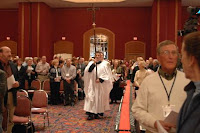
3) The narrow view:

(a) Good roommate times. One of my roommates was also at the conference, and we had an awesome time together of discussion, fun, and observation of awkwardness. It was one of those special times of getting to know a good friend even better and being privileged to see inner beauty and be affirmed in return. Plus, we got to, umm, imbibe (ah, the goodness of the Scotch!) with the rest of the staff at a "family establishment" called the Idle Rich. And, we got to see Juno after my bedtime.

(b) Personal clarity. In recent months, I have been wrestling with issues of calling and vocation. After being at conference, I am 99% sure that I am called to stay at Redeemer until "further notice." I long to dive into ministry, pour into people, learn to build a community; I see God working in my life and in my church, and I cannot walk away from that. PhD? Someday, perhaps, but in the meantime I believe I am ready (and called, and placed in my communities specifically) for action!

(c) Denominational clarity. I finally have a decent sense of what AMiA is, and what it means to be Anglican. If anyone is interested, I am more than happy to post Bishop John Roger's excellent synthesis of Anglicanism. After hearing him speak in a workshop, I realized that yes, I am Anglican! Good thing...

4) The far-beyond myself:
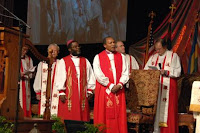
(a) Rwanda. I love, love, love the fact that we are under the authority of the bishops of Rwanda. I loved, loved, loved seeing and hearing from the bishops at the conference, especially in the final consecration ceremony when all the bishops were gathered on stage, lined up in a row as they laid hands on the new bishops, a brilliant wall of red in their vestments. I love the justice of Americans finally recognizing the value, indeed in many ways the greater spiritual maturity of Global Christianity.

(b)
God at work. After being at the conference, I am absolutely convinced that AMiA is God's project. I believe that we are in the middle of something big, something exciting, something utterly of the Spirit. Now, I tend to be cautious when I feel this way, since I never want to confuse my own intuition with recognition prompted by the Spirit, but at this point I can see the vision of AMiA, the commitment of the AMiA leaders, and the unique combination of factors that is fundamental to AMiA, and it leaves me breathless with gratitude that the Lord has allowed me to be a part of His work. I can't explain it fully -- I just watch, wait, respond, and pray.

Pray for AMiA. Pray for the church in America. Pray for revival from the Spirit. Pray for faithful leaders. Watch and pray, watch and pray.

BTW: the photos above are from an online article about the conference, by David W. Virtue. Check it out at http://www.virtueonline.org/portal/modules/news/article.php?storyid=7561